Hedge Robotics
A team of small AI models that outperforms the big ones.
What We Build
A living environment for AI models that learn and work as a team. Each model is a building block — easy to replace, retrain, or upgrade. They share data, pass context to each other, and evolve continuously — without breaking what already works.
How It Works
Training & Evaluation Environment
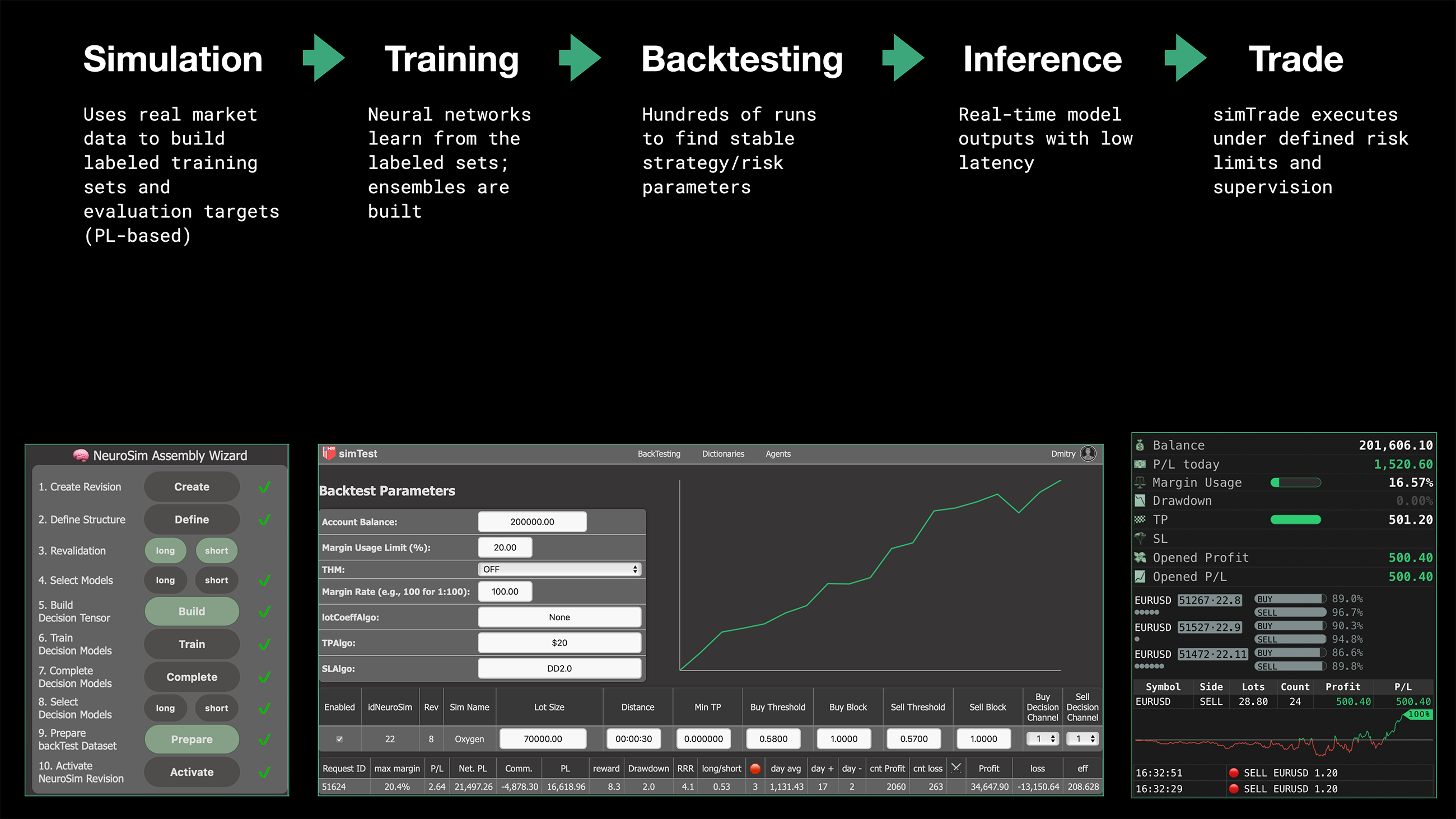
Models are born in simVault — a purpose-built environment where they are trained, tested, and tracked from day one. Every experiment, every metric, every version is recorded. Training is distributed across multiple machines, working in parallel. In simVault, each model has an identity — not just weights, but a full history of how it learned and how well it performs.
From Models to Ensembles
A single model sees one thing. An ensemble sees the whole picture. After training, models are grouped into teams — called neurosims — where each one plays a specific role. Some read signals, some make decisions, some provide context. Each model plugs into shared data channels like a module, so new models can join the team without rebuilding what's already running.
Continuous Evolution
Over time, models become outdated: market conditions change, metrics decline, new data emerges. The system supports model revisions, automatic revalidation, and replacement of models in the live environment without stopping the process. Evolution is not a one-time model upload, but continuous updates based on metrics.
Why small?
Large language models are remarkable — but they're built to know everything about everything. When your task is specific, most of that power goes to waste.
Small models are different. They do one thing, and they do it well. They train in hours, not months. They run in milliseconds, not seconds. And when the world changes — you retrain and redeploy one model, not rebuild the whole system.
In our architecture, each model is a specialist. One reads price momentum. Another tracks volatility. A third watches correlations. On their own, they're simple. Together, they see what no single model can.
And when a model stops performing? We detect it, replace it, and move on — without touching anything else. Try doing that with a billion-parameter monolith.
Small doesn't mean weak. It means fast, focused, and disposable. That's how you build AI that actually evolves.
Real-World Deployment
Hedge Robotics is not a research environment. Models trained and evolved in simVault are deployed into real systems, where their performance has tangible consequences.
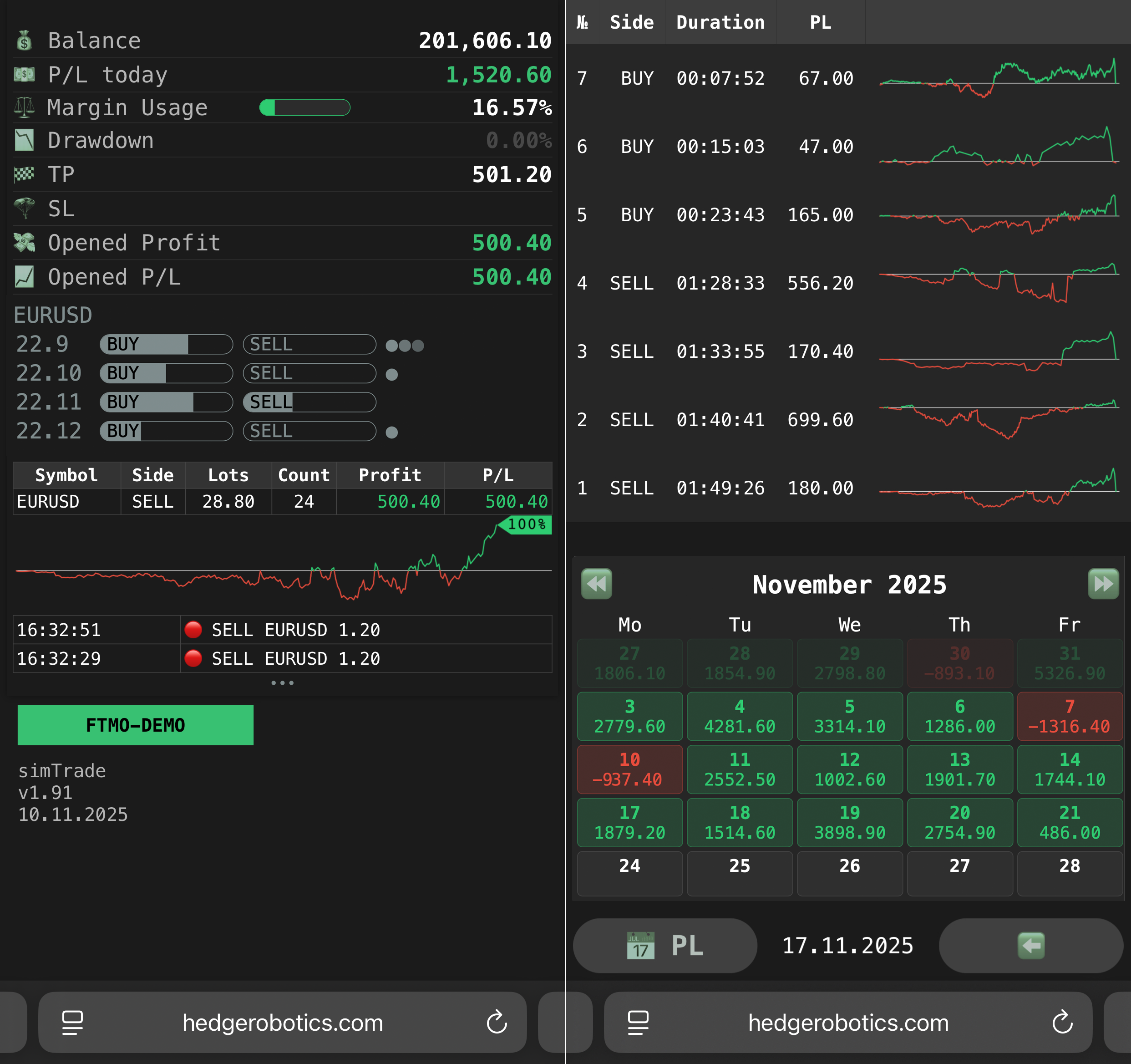
One of these systems is simTrade — a trading pipeline that operates on live financial data and executes real positions based on model ensembles. simTrade reads market data in real time, feeds it into the inference environment, and lets the ensemble do its work — from signal detection to entry and exit decisions. Every result flows back to simVault as feedback, closing the loop between live performance and future training.
Vision
Today, our models trade financial markets. Tomorrow, the same architecture could power something much larger.
The idea is simple: instead of one massive AI trying to do everything, you build a team of small specialists — each one fast, focused, and replaceable — coordinated by a higher-level model that sees the full picture.
This is how biological intelligence already works. You don't use conscious thought to keep your balance or catch a falling glass. Dedicated systems handle that in milliseconds. Consciousness steps in for language, planning, and decisions. Two layers — fast reflexes and slow reasoning — working together.
We believe this is how real-world AI should work too. An autonomous vehicle doesn't need a large language model to stay in its lane — it needs a tiny model with a 10-millisecond response time. But to explain to a passenger why it chose a different route — that's where language and reasoning come in.
Our architecture — specialized models coordinated by a meta-layer — is not limited to trading. It's a blueprint for any system where AI needs to act in the real world: robotics, autonomous vehicles, smart infrastructure, industrial automation.
Small models that do. A meta-model that thinks. Together, they evolve.